The Hidden Mechanism Behind Weight Regain — And the Study That Finally Explained It
New research from one of the world’s largest health studies reveals why lasting weight loss is neurologically impossible for millions of women — until one specific thing changes.
SH
Sarah Henley, HealthuMind Contributor
March 18, 2026 · 16 min read
It’s 11:47pm and you’re standing in your kitchen.
The house is quiet. Everyone’s asleep. The only light is the one above the stove and the pale glow from inside the fridge, which you’ve just opened for the second time in ten minutes.
You’re not hungry. You know you’re not hungry. You ate dinner four hours ago and it was fine — it was healthy, it was portioned, it was everything you’re supposed to eat. You did everything right today.
And now you’re standing here anyway, hand reaching for something you swore you wouldn’t touch, and the voice in your head is already running: Why can’t you just stop? What is wrong with you? You were doing so well. You always do this. You always, always do this.
You eat standing up. In the dark. Fast enough that you don’t have to think about it. And then you eat a little more, because at this point, what does it matter? The day is already ruined. You’re already ruined.
You close the fridge. You stand in the dark kitchen for a moment. And then comes the feeling you know better than almost any other feeling in your life — that sick, heavy wave of shame that starts in your stomach and rises into your chest and throat.
You go to bed carrying it. You’ll wake up carrying it. Tomorrow you’ll start again, or you’ll tell yourself you’ll start Monday, and the whole time there will be a quiet voice underneath everything — a voice you’ve been hearing for years, maybe decades — that says:
Something is fundamentally wrong with me.
If you just read that and felt something clench inside your chest — if it felt less like reading and more like being watched — then this is for you. Not because I know your name. Because I know the pattern. It’s the same pattern. It’s always the same pattern. And after what you’re about to read, you’ll understand exactly why.
For millions of women, the pattern is identical. The details change. The loop doesn’t.
The Cycle
You’ve Tried Everything. You Know You’ve Tried Everything. So Why Are You Still Here?
Let’s be honest about what “trying everything” actually looks like. Not the polished version. The real one.
It looks like spending hundreds — sometimes thousands — of dollars on programmes, plans, supplements, coaches, apps, memberships, and meal delivery services. It looks like losing 20, 30, 40 pounds and feeling that brief, intoxicating rush of hope — the one that whispers this time it’s different.
It looks like your husband telling you that you look beautiful, and instead of feeling happy, feeling a strange, wordless sense of dread.
It looks like gaining it all back. Sometimes slowly, over months. Sometimes shockingly fast — 15 pounds in three weeks, as if your body was racing to get back to a number it needed to reach.
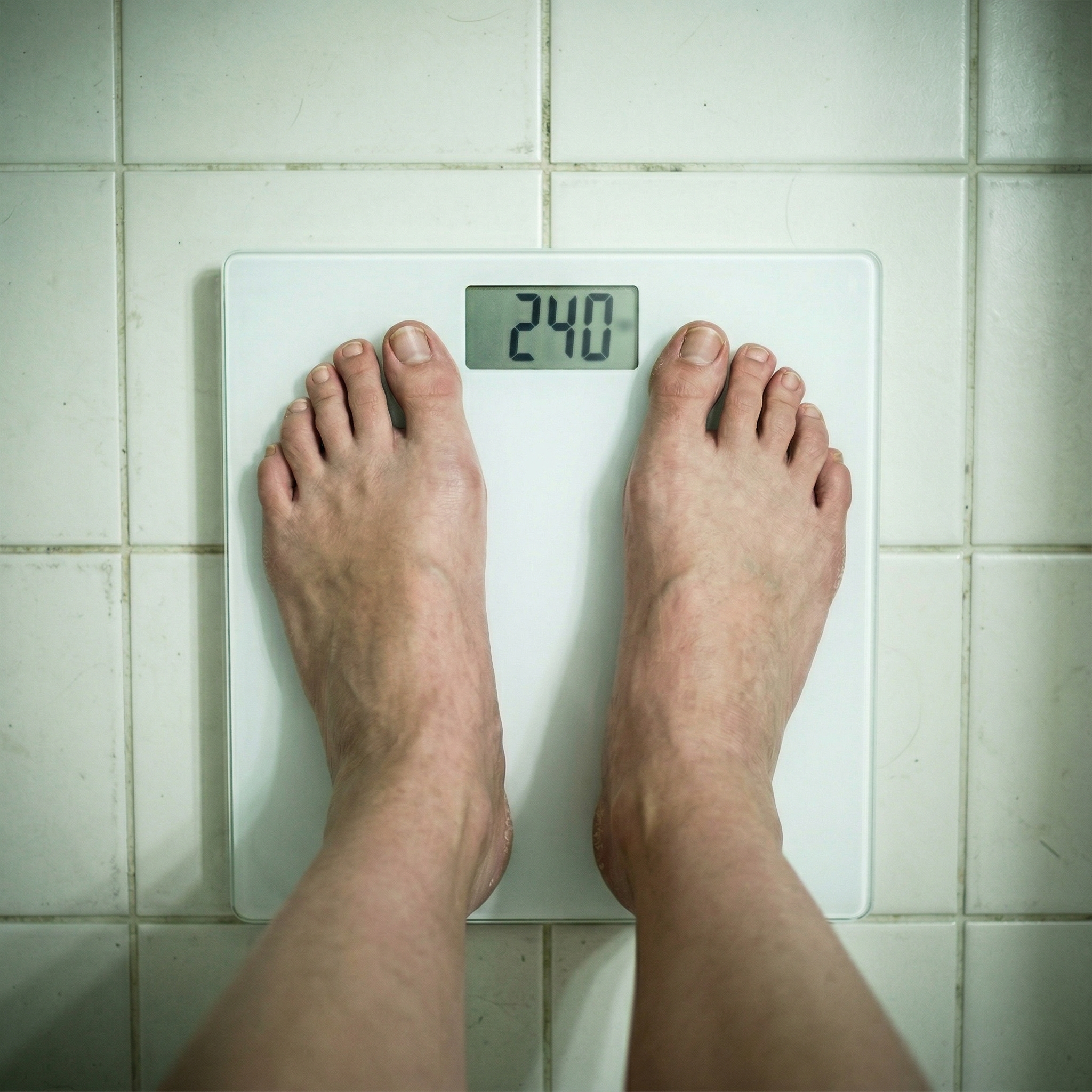
It looks like standing on a scale and doing maths in your head about how many days it would take to undo the damage, knowing even as you calculate that you probably won’t make it.
The number that becomes the first thought of the day.
And underneath all of it — underneath every attempt and every failure — it looks like a woman who is exhausted. Not physically. Existentially. Tired of fighting a war she keeps losing against her own body. Tired of waking up and having the first thought of the day be about food, or weight, or what she looks like, or what she ate last night. Tired of the sheer amount of mental real estate this takes up — the constant tracking, negotiating, calculating, bargaining, punishing, forgiving, starting over.
You didn’t end up here because you lack discipline. You are one of the most disciplined people you know. You’ve proved it over and over. That’s the part that makes this so maddening — you have done everything right, multiple times, and it still didn’t hold.
So let me ask you the question that nobody in the weight loss industry will ever ask, because the entire industry depends on you never hearing the answer:
What if the problem was never your discipline, your willpower, your knowledge, or your effort?
What if the problem was that every single approach you’ve ever tried was working on the wrong level?
The Lie
The Diet Industry Doesn’t Want You to Read What Follows. Because Your Failure Is Their Revenue Model.
A $300 billion industry built on a model that requires your repeated failure.
Here is an uncomfortable truth that a $300-billion-a-year industry has no incentive to share with you:
They know diets don’t produce lasting results. They have always known.
The research is unambiguous. Between 80% and 95% of people who lose weight through dieting regain it within 2–5 years. This is not a new finding. This has been consistently documented for over four decades. The industry knows it the way tobacco companies knew cigarettes were addictive — and they responded the same way: by designing a business model around it.
Think about it. If diets worked permanently, you’d buy one programme, lose the weight, and never come back. The company would make one sale. Game over.
But if diets fail — if they work just long enough to create hope, and then stop working in a way that makes you blame yourself — then you come back. You buy the next programme. The next app. The next supplement. The next coach who tells you that this time, this method, this approach is the one that will finally stick.
The diet industry is not designed to make you thin. It is designed to make you a repeat customer. Your failure is not a bug in their system. It is the system.
And the cruelest part? Every time you “fail,” you don’t blame the method. You blame yourself. You absorb it as evidence of your own weakness, your own lack of discipline, your own fundamental brokenness. The shame deepens. The self-worth erodes a little more. And the next time a new programme promises hope, you’re even more desperate to try it.
This is not an accident. This is architecture.
But there is something the industry doesn’t just hide from you — something that, if you understood it, would make you furious. Because it would mean that none of this — not one pound of the weight you’ve regained, not one night spent hating yourself in front of the fridge — was ever your fault.
The Discovery
In the 1980s, a Doctor Discovered Why the Weight Keeps Coming Back. The Answer Changed Everything.
Dr. Vincent Felitti was running one of the most successful obesity clinics in America. Patients were losing dramatic amounts of weight. By every conventional measure, the programme was working.
Then something happened that nobody could explain.
The patients who were losing the most weight — the biggest success stories — were dropping out. Not plateauing. Not slowing down. Vanishing. Walking away from a programme that was objectively working, often at the exact moment of their greatest progress.
When Dr. Felitti tracked them down and asked what had happened, what they told him changed the course of public health research forever.
Dr. Felitti started asking the question no one in weight loss had thought to ask.
One woman had lost 40 pounds in four months — then gained it all back in three weeks. Not gradually. In three weeks. When asked why, she said something no one in weight loss medicine had ever thought to listen to:
“When I was overweight, men didn’t look at me. When I lost the weight, they started looking. And I couldn’t stand it. The weight made me feel safe.”
She had been sexually assaulted at 23. The weight wasn’t a problem she was failing to solve. It was a solution her body had created to solve a much bigger problem: survival.
Dr. Felitti didn’t dismiss this. He started asking every patient about their childhood. What he found became the ACE Study — the Adverse Childhood Experiences Study — the largest study of its kind ever conducted, in partnership with the Centers for Disease Control, with over 17,000 participants.
The results were staggering:
6M+
Women in the US alone affected by ACE-linked weight patterns
2×
Increased obesity risk with 4+ adverse childhood experiences
40%
Of significantly overweight patients had experienced sexual abuse
The study proved what Dr. Felitti’s patient had been telling him all along: for millions of women, the weight is not the problem. The weight is the solution their body created to keep them safe.
Related Reading
The research documented in this article led to a specific programme. Women who completed it describe their experience below.
Your Body Is Not Failing You. It Is Protecting You. And Until You Understand From What — Nothing Will Change.
Your subconscious mind is the most powerful protection system you will ever encounter. It runs your heartbeat, regulates your breathing, triggers your fight-or-flight response — all without asking your permission.
And at some point in your life — often so early you may not even consciously remember it — it made a decision about your body.
Maybe the decision was: if I’m bigger, I’m less visible. If I’m less visible, I’m safer.
Maybe it was: when I eat, I feel something other than what I’m feeling. And what I’m feeling is unbearable.
Maybe it was: I have been told in a thousand ways that I am too much — too loud, too needy, too emotional, too much. So I’ll shrink who I am on the inside and let my body grow on the outside, because at least that kind of “too much” doesn’t get me abandoned.
These are not weaknesses. They are not character flaws. They are the most intelligent responses available to a nervous system that learned the world wasn’t safe.
The body’s armour. Worn not out of weakness, but survival.
And here is what makes this so devastating, and what no diet programme has ever acknowledged:
You cannot out-discipline a subconscious protection mechanism.
You cannot out-willpower it. You cannot out-diet it, out-exercise it, or out-therapy it. Your nervous system will override every conscious effort you make — because in its logic, it is keeping you alive.
This is why you can lose 30 pounds and gain it back in three weeks. This is why cravings hit hardest at the exact moment you’re making progress. This is why losing weight makes you feel strangely anxious, exposed, unsafe — and why the regain feels, in some terrible way, like relief.
Your body is not broken. Your willpower is not deficient. You have been fighting the wrong enemy for your entire adult life.
“You weren’t weak. You were being protected.”
The Cost
Here Is What Happens If Nothing Changes. And You Already Know This, Even If You Haven’t Let Yourself Think It.
Five years from now, you are still in this cycle. You are five years older, five years more exhausted, and the pattern has not loosened its grip by a single degree. The hope you used to feel at the start of a new programme is gone. You don’t even start any more. You’ve accepted this is just who you are.
Your daughter — or your niece, or the girl down the road who looks up to you — has been watching. She has learned, without a single word being spoken, that a woman’s body is a problem to be solved. She is twelve and she has already started skipping meals. She doesn’t know why. She just knows her body doesn’t feel right. The cycle has already begun in her.
She is watching. She is learning. The cycle does not end with you — unless you end it.
Your relationship has quietly hollowed out. Not because of a fight. Because of what you won’t let your partner see. Because you change in the bathroom with the door locked. Because intimacy feels like exposure, and exposure feels like danger, and so you’ve built a wall so slowly and so carefully that neither of you noticed it going up until you were both on opposite sides of it.
Your health has started sending signals you can no longer ignore. Your knees. Your back. Your blood pressure. Your doctor uses words like “pre-diabetic” and you nod and you file it away in the part of your brain where you keep all the things that are too heavy to look at directly.
And the worst part — the part that wakes you up at 3am sometimes — is the knowledge that you have spent the best years of your life at war with your own body. That while other things were happening — your children growing, your career building, your friendships deepening — a portion of your mind, every single day, was occupied with counting, restricting, failing, and hating yourself for it.
That is the real cost. Not the weight. The life that gets consumed by the war.
This does not get better on its own. The pattern does not soften with time. It deepens. The neural grooves get deeper, the shame gets heavier, the window of possibility feels like it’s closing. Because it is.
Unless something changes at the level where the pattern actually lives. Not what you eat. Not how you move. Not what you understand. What your nervous system believes.
The Science
Researchers Have Known for Decades That Lasting Change Cannot Happen at the Behavioural Level. Here Is Where It Actually Happens.
Diets change what you eat. They operate at the level of behaviour.
Exercise programmes change how you move. They operate at the level of behaviour.
Therapy helps you understand why you eat. Understanding is a conscious process. The protection mechanism is subconscious. You can spend twenty years in therapy developing extraordinary insight into your patterns and still find yourself standing at the fridge at 11pm, doing the very thing you understand completely and cannot stop.
The reason is simple: you cannot fix a subconscious programme with a conscious tool. It’s like trying to rewrite the operating system of a computer by typing instructions into a Word document. The right information, the wrong level.
What actually changes subconscious patterns? Three decades of neuroscience research point to the same conclusions:
Finding One — The Brain Must Be in a Specific State
Theta brainwaves (4–8 Hz) characterise the hypnagogic state — the threshold between waking and sleep. In theta, the critical faculty goes quiet. The subconscious becomes accessible. Neuroplasticity reaches its peak. This is measurable, reproducible brain activity that neuroscientists can observe in real time.
The theta state: the narrow window between waking and sleep where the subconscious opens.
Finding Two — The Subconscious Responds to Story, Not Instruction
Milton Erickson, the most effective hypnotherapist in history, proved that direct commands to the subconscious produce resistance. But indirect suggestion — metaphor, permissive language, gentle therapeutic narrative — bypasses resistance entirely.
93%
Improvement rate with clinical hypnotherapy (6 sessions)
38%
Improvement rate with traditional talk therapy (600 sessions)
Neural pathway activity during theta state — the brain’s most receptive window for subconscious change.
Finding Three — The Brain Rewires Through Repetition and Rest
Theta state is the most powerful window for subconscious change you will ever have access to. And neuroplasticity requires repetition — each exposure deepens the new neural pattern. This is why the programme is structured across 21 days in three phases: what opens in the first week deepens in the second and integrates in the third.
What if you gave your brain exactly the right input during theta state — not once, but across 21 days of structured repetition designed to rewrite the programme that’s been keeping you stuck?
The Programme
21 Days to Body Freedom. Not Another Diet. The Thing You Do After Every Diet Has Failed.
21 Days to Body Freedom — a theta-frequency subconscious rewiring programme for women who have tried everything else.
This is a 21-day therapeutic audio programme that uses theta-frequency sound to rewire the subconscious patterns behind the weight. Built for women who have tried everything else. Women who are not lacking in effort, discipline, or self-awareness — but who have been working at the wrong level for years.
Seven core sessions. Fifteen minutes each. Listened to across three phases — Opening, Deepening, and Integration — so the rewiring builds and consolidates over 21 days. No concentration required. No journaling. No homework. No willpower.
The programme uses three therapeutic layers delivered simultaneously when the brain enters theta state — its most receptive window for subconscious change:
The Three-Layer Method
Theta binaural beats — precisely calibrated 6 Hz frequencies guide your brain into the theta state within minutes — opening the subconscious window that makes everything else possible. This is why the programme doesn’t require concentration or effort. It meets your brain in the state where subconscious change is neurologically possible.
Ericksonian hypnotherapy — no commands. No affirmations you have to force yourself to believe. Instead: indirect suggestion, metaphor, and gentle therapeutic narrative that works with your subconscious rather than against it. Where traditional approaches tell you what to believe, this approach creates the conditions for your subconscious to arrive at new beliefs on its own.
Somatic nervous system work — drawing on polyvagal theory, Internal Family Systems, and somatic experiencing to communicate safety at a biological level. Not the idea of safety. The felt sense of it. This is what rewires the protection mechanism. When your nervous system genuinely believes the danger is over — not as a concept, but as a bodily reality — it releases its grip on the weight it’s been holding.
You don’t have to concentrate. You don’t have to journal or do homework or think about any of this during your day. Many women listen at bedtime. Others use a quiet moment during the day. The programme meets you wherever you can give it fifteen uninterrupted minutes.
“You press play. You close your eyes. Your brain does the work.”
The Seven Sessions — Across Three Phases
The programme contains seven core therapeutic sessions. Each is listened to three times across 21 days — structured in three phases so the rewiring builds and consolidates.
1
Session One
The Unveiling
Meets the part of you that’s been trying to keep you safe. Names the pattern without blame.
2
Session Two
The Safety Signal
Deep nervous system regulation. Teaches your body: the danger is over.
3
Session Three
The Release
Targets stored emotional weight — grief, shame, guilt that was never yours to carry.
4
Session Four
The Wound
The deepest session. Returns to where the core belief was first formed and rewrites the conclusion.
5
Session Five
The Permission
Dismantles the “I am too much” belief. Reclaims the right to be seen, to take up space, to want.
6
Session Six
The Rewiring
Installs the new truth at the subconscious level. I am safe. I am enough. I am free.
7
Session Seven
The Becoming
Meets the woman you’re already becoming. Bridges who you are now with who you’re stepping into.
Why 21 Days — Not 7
The seven sessions contain the complete therapeutic arc. But neuroscience is clear: a single exposure opens a new neural pathway. Repetition is what makes it permanent.
That’s why 21 Days to Body Freedom is structured in three phases:
Days 1–7 — Opening
You hear each session for the first time. The subconscious begins to recognise new patterns.
Days 8–14 — Deepening
You hear each session again. The theta-frequency delivery deepens the neural grooves formed in the first week. Most women report this is when the shifts become tangible.
Days 15–21 — Integration
The final pass. The new beliefs consolidate. The old protection patterns begin to release their grip — not through force, but because the nervous system no longer needs them.
By Day 21, your subconscious has received each session three times in theta state. The rewiring isn’t surface-level. It’s structural.
Real Women
They Were in the Same Place You Are. This Is What Shifted.
Documented Experiences
“I have spent twenty years in therapy. I understand my patterns completely — I could draw you a diagram of why I eat the way I do. And every single night, I’d still find myself in the kitchen, doing the exact thing I understood perfectly and could not stop. After Session 4, something changed that twenty years of understanding never touched. The urge isn’t there the way it was. I keep waiting for it to come back. It’s been six weeks.”
Jessica T. · London · Age 44
“I’d wake up at 3am every night, grab my phone, start the anxious scrolling, and end up in the kitchen. Every night. For years. I fell asleep during Session 1 and woke up annoyed I’d missed it. But that night, when I woke at 3am, I just... went back to sleep. I didn’t reach for the phone. I didn’t go to the kitchen. I thought: that’s odd. Now I think something happened while I was sleeping that years of other approaches never did.”
Sarah M. · Sydney · Age 38
“My mother put me on my first diet when I was nine. Nine. I have been counting calories for thirty-two years. The Mother Wound session reached something so deep I didn’t even know it was there. I cried for an hour. Not sad crying — the kind where something heavy finally leaves your body. I have felt physically lighter since. And I don’t mean the number on the scale.”
Rachel K. · Toronto · Age 51
“What I notice most is what isn’t happening anymore. I’m not counting. I’m not planning. I’m not negotiating with myself about food. I’m not lying in bed reviewing everything I ate. The war just... got quiet. I didn’t realise how much of my life it was consuming until it stopped.”
Amanda L. · Manchester · Age 36
Related Reading
The accounts above represent a fraction of documented responses. The full programme details, methodology, and access information are available here.
You Have Two Options Right Now. Only One of Them Is New.
What the morning after feels like when something has finally shifted.
Option one: you close this page. Tomorrow looks the same as today. You start again, or you tell yourself you’ll start Monday, and the cycle continues. Not this week, not this month, not this year. Five years from now, you are still here.
Option two: you press play. Fifteen minutes. In a quiet moment. You don’t have to believe it will work. You don’t have to earn it. You don’t have to be ready. You just have to be tired enough of the alternative.
This programme was built for the woman who has tried everything. Not to give her another thing to try. To work at the level where everything else failed — because everything else was operating in the wrong part of her brain.
Twenty-one days. Fifteen minutes. No willpower.
Your body has been waiting — not to betray you, not to resist you — but to hear that it is finally allowed to put down what it’s been carrying.
This could be the moment it hears that.
A HealthuMind Recommendation
21 Days to Body Freedom
A 21-day theta-frequency subconscious rewiring programme for women who have tried conventional approaches without lasting results. Built on the research documented in this article — theta-state delivery, Ericksonian methodology, somatic nervous system regulation, and structured repetition across three phases.
HealthuMind may receive compensation for this recommendation. Editorial standards apply.
This article is produced in partnership with an independent wellness programme and contains sponsored content. It is intended for educational and informational purposes. 21 Days to Body Freedom is a personal development and wellness programme and is not a substitute for medical or psychological treatment. Individual results vary. If you are experiencing a diagnosed eating disorder, please consult your healthcare provider before beginning.
Sources: Kaiser Permanente ACE Study (Dr. Vincent Felitti); CDC Adverse Childhood Experiences Study; Comparative study on hypnotherapy vs. talk therapy efficacy; Phillippa Lally, UCL — European Journal of Social Psychology; Dr. Bessel van der Kolk, The Body Keeps the Score; PMC/NIH 2025 EFT study; Stephen Porges, Polyvagal Theory.
Continue reading: The programme documented in this articleView programme →